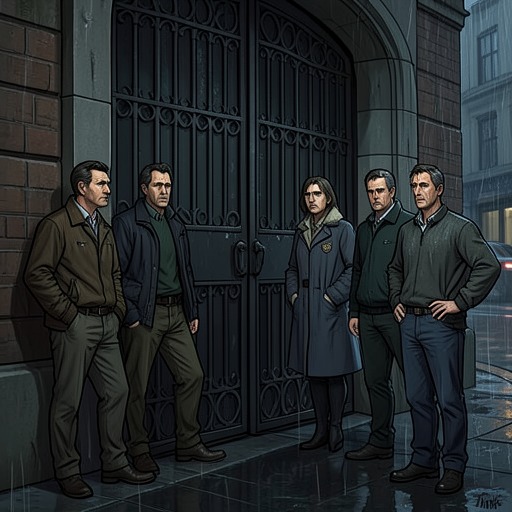
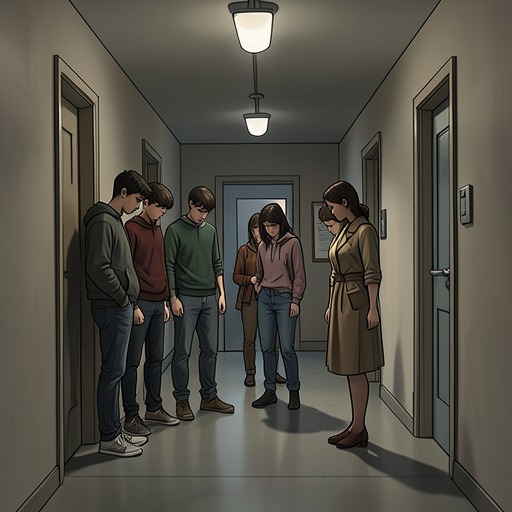
McCormick student interviews
Defending JacobThe McCormick student interviews begin as an attempt to find witnesses after Ben Rifkin’s murder and become an unsettling indication that students may know more than they are willing to say. Conducted by Andrew Barber, Paul Duffy, and other investigators under rules negotiated with the school, the interviews move the case from a search for individual clues toward the possibility of a wider silence among Ben’s classmates.
Setting and Conditions
The interviews start after school, following a day of class meetings and grief counseling. Plainclothes CPAC detectives have gone from classroom to classroom asking students to share tips, anonymously if they prefer; the children’s dull response gives little immediate promise of cooperation. The investigators’ access is limited by the school’s insistence on safeguards. Students outside Ben’s homeroom are off limits unless there is a specific reason to think they may know something, and a student may have a parent or lawyer present and may end an interview at any time.
The restrictions follow direct intervention by the school board and the mayor, who press Lynn Canavan to slow the investigation. The school principal initially refuses to let the investigators interview any student they choose. Andrew recognizes that the investigators would have acted differently had the crime occurred in an urban setting, but in this suburban community they negotiate rather than simply enter. Although he regards many of the eventual conditions as rights the children already possess, he sees the negotiations as costing valuable time. The rules protect the students while also making the interviews a contested public matter.
Interviews and the Emerging Pattern
At two o’clock, Andrew and Paul take over the principal’s office to interview their highest-priority witnesses: Ben’s close friends, students known to walk through Cold Spring Park, and students who have specifically asked to speak with investigators. Two dozen interviews are scheduled for the pair, while other CPAC detectives conduct interviews in parallel. Andrew expects most conversations to be brief and unproductive; the investigators are, in his image, casting a broad net rather than following a settled lead.
After only three or four interviews, that expectation gives way to suspicion. At first, Andrew and Paul interpret the students’ shrugs, evasions, wandering eyes, and casual verbal habits as ordinary adolescent resistance to adults. Their experience as fathers makes that explanation seem plausible. But the answers go beyond claims of ignorance: some students deny knowing Ben at all, while others claim that nobody spoke to him or knew who had harmed him. Andrew and Paul already know that Ben had friends, so the denials appear not merely incomplete but false. For Andrew, the friends’ sudden disavowal of Ben reads as a betrayal.
The students’ varying attempts to appear truthful sharpen rather than resolve the investigators’ concern. Some overplay signs they associate with honesty, becoming unusually direct and self-assured when making implausible denials; others seem uncomfortable even as they lie. Andrew notes that these behaviors do not establish what any particular student knows. Their significance lies in the accumulating pattern: the interviews are not producing ordinary gaps in memory or knowledge but accounts that seem shaped to conceal association with the victim.
From Canvassing to Suspected Silence
As the interviews continue, Andrew and Paul exchange suspicious glances and slow the process to challenge the clearest falsehoods. Paul jokes that the students are observing a code of silence, but neither investigator says aloud what he is beginning to suspect. The mood changes from routine witness-gathering to the sense that the investigation has opened onto a new possibility.
Until then, they had considered and discounted the possibility that another student was involved. They had seen no evidence pointing to a student suspect, no obvious outcast, no trail of careless schoolboy evidence, and no clear motive in the form of revenge, outlaw fantasies, or a classroom feud. The interviews unsettle that assessment. They do not identify a culprit or explain why the students are evasive; they do establish, for Andrew and Paul, that the children may collectively know something they are withholding. The turn matters precisely because suspicion arrives without a corresponding answer.
The Question Behind the Investigation
The interviews belong to a larger struggle over what the investigation can establish and what the death means to those left behind. Dan Rifkin asks Andrew why the person who killed Ben did it, insisting that he has questions beyond evidence and court procedure. He then asks what distinguishes parents who manage to survive the loss of a child and what happens to those who never recover. Andrew’s response is to recommend family and community support, a victim advocate, and a survivors’ group; he stresses that grief cannot be borne alone.
Dan’s questions give the interviews a human context without supplying an explanation for the students’ behavior. The case is at once a procedural inquiry into who knew what and a bereaved father’s attempt to find meaning and a way to endure. When Dan later appears near the park during the search, Andrew remembers him as a small, solitary figure crossing the open playing fields with his head bowed and his hands in his coat pockets. That image underscores how little the investigative process can do for the personal question Dan cannot set aside.
Narrative Significance
The interviews also expose how easily a community’s ordinary routines can become a barrier to knowledge. The students are not presented as a single, proven conspiratorial group; the evidence shows a repeated pattern of denial that causes Andrew and Paul to revise their earlier judgment. The distinction is important: the interviews produce suspicion, not a definitive account of who is responsible or what the students know.
The episode’s force comes from that gap between what the investigators expected and what they encounter. A school canvass designed to gather small, individual observations instead reveals the possibility of collective silence. In the wider narrative, that reversal anticipates the difficulty of separating evidence from assumption: the investigators must take the denials seriously enough to question their initial theory, while the interviews themselves leave the central questions unresolved.